NCERT Solutions For Class 10 Maths Chapter 12 Areas Related to Circles
NCERT Solutions for Class 10 Maths Chapter 12 Areas Related to Circles is an important study resource needed for the students in Class 10. These questions help the students in understanding the types of questions that will be asked in the exams. Solutions to all areas related to circles help students in preparing for the exams in an effective way. These NCERT solutions, available at BYJUS, will help students to ace their exams by preparing them well in advance. Get free NCERT Solutions for Class 10 Maths, Chapter 12 Areas Related to Circles and clear all doubts on the concept. To assist the students of 10th Class to be better prepared for their board exams, the experts have formulated these solutions, based on CBSE syllabus of NCERT book.Chapter 12 Areas Related to Circles
Download PDF of NCERT Solutions for Class 10 Maths Chapter 12 Areas Related to Circles


Access Answers of Maths NCERT Class 10 Chapter 12 – Areas Related to Circles
Class 10 Maths Chapter 12 Exercise: 12.1 (Page No: 230)
Exercise: 12.1 (Page No: 230)
1. The radii of two circles are 19 cm and 9 cm respectively. Find the radius of the circle which has a circumference equal to the sum of the circumferences of the two circles.
Solution:
The radius of the 1st circle = 19 cm (given)
∴ Circumference of the 1st circle = 2π×19 = 38π cm
The radius of the 2nd circle = 9 cm (given)
∴ Circumference of the 2nd circle = 2π×9 = 18π cm
So,
The sum of the circumference of two circles = 38π+18π = 56π cm
Now, let the radius of the 3rd circle = R
∴ The circumference of the 3rd circle = 2πR
It is given that sum of the circumference of two circles = circumference of the 3rd circle
Hence, 56π = 2πR
Or, R = 28 cm.
2. The radii of two circles are 8 cm and 6 cm, respectively. Find the radius of the circle having area equal to the sum of the areas of the two circles.
Solution:
Radius of 1st circle = 8 cm (given)
∴ Area of 1st circle = π(8)2 = 64π
Radius of 2nd circle = 6 cm (given)
∴ Area of 2nd circle = π(6)2 = 36π
So,
The sum of 1st and 2nd circle will be = 64π+36π = 100π
Now, assume that the radius of 3rd circle = R
∴ Area of the circle 3rd circle = πR2
It is given that the area of the circle 3rd circle = Area of 1st circle + Area of 2nd circle
Or, πR2 = 100πcm2
R2 = 100cm2
So, R = 10cm
3. Fig. 12.3 depicts an archery target marked with its five scoring regions from the centre outwards as Gold, Red, Blue, Black and White. The diameter of the region representing Gold score is 21 cm and each of the other bands is 10.5 cm wide. Find the area of each of the five scoring regions.

Solution:
The radius of 1st circle, r1 = 21/2 cm (as diameter D is given as 21 cm)
So, area of gold region = π r12 = π(10.5)2 = 346.5 cm2
Now, it is given that each of the other bands is 10.5 cm wide,
So, the radius of 2nd circle, r2 = 10.5cm+10.5cm = 21 cm
Thus,
∴ Area of red region = Area of 2nd circle − Area of gold region = (πr22−346.5) cm2
= (π(21)2 − 346.5) cm2
= 1386 − 346.5
= 1039.5 cm2
Similarly,
The radius of 3rd circle, r3 = 21 cm+10.5 cm = 31.5 cm
The radius of 4th circle, r4 = 31.5 cm+10.5 cm = 42 cm
The Radius of 5th circle, r5 = 42 cm+10.5 cm = 52.5 cm
For the area of nth region,
A = Area of circle n – Area of circle (n-1)
∴ Area of blue region (n=3) = Area of third circle – Area of second circle
= π(31.5)2 – 1386 cm2
= 3118.5 – 1386 cm2
= 1732.5 cm2
∴ Area of black region (n=4) = Area of fourth circle – Area of third circle
= π(42)2 – 1386 cm2
= 5544 – 3118.5 cm2
= 2425.5 cm2
∴ Area of white region (n=5) = Area of fifth circle – Area of fourth circle
= π(52.5)2 – 5544 cm2
= 8662.5 – 5544 cm2
= 3118.5 cm2
4. The wheels of a car are of diameter 80 cm each. How many complete revolutions does each wheel make in 10 minutes when the car is travelling at a speed of 66 km per hour?
Solution:
The radius of car’s wheel = 80/2 = 40 cm (as D = 80 cm)
So, the circumference of wheels = 2πr = 80 π cm
Now, in one revolution, the distance covered = circumference of the wheel = 80 π cm
It is given that the distance covered by the car in 1 hr = 66km
Converting km into cm we get,
Distance covered by the car in 1hr = (66×105) cm
In 10 minutes, the distance covered will be = (66×105×10)/60 = 1100000 cm/s
∴ Distance covered by car = 11×105 cm
Now, the no. of revolutions of the wheels = (Distance covered by the car/Circumference of the wheels)
=( 11×105)/80 π = 4375.
5. Tick the correct Solution: in the following and justify your choice : If the perimeter and the area of a circle are numerically equal, then the radius of the circle is
(A) 2 units
(B) π units
(C) 4 units
(D) 7 units
Solution:
Since the perimeter of the circle = area of the circle,
2πr = πr2
Or, r = 2
So, option (A) is correct i.e. the radius of the circle is 2 units.
Exercise: 12.2 (Page No: 230)
1. Find the area of a sector of a circle with radius 6 cm if angle of the sector is 60°.
Solution:
It is given that the angle of the sector is 60°
We know that the area of sector = (θ/360°)×πr2
∴ Area of the sector with angle 60° = (60°/360°)×πr2 cm2
= (36/6)π cm2
= 6×22/7 cm2 = 132/7 cm2
2. Find the area of a quadrant of a circle whose circumference is 22 cm.
Solution:
Circumference of the circle, C = 22 cm (given)
It should be noted that a quadrant of a circle is a sector which is making an angle of 90°.
Let the radius of the circle = r
As C = 2πr = 22,
R = 22/2π cm = 7/2 cm
∴ Area of the quadrant = (θ/360°) × πr2
Here, θ = 90°
So, A = (90°/360°) × π r2 cm2
= (49/16) π cm2
= 77/8 cm2 = 9.6 cm2
3. The length of the minute hand of a clock is 14 cm. Find the area swept by the minute hand in 5 minutes.
Solution:
Length of minute hand = radius of the clock (circle)
∴ Radius (r) of the circle = 14 cm (given)
Angle swept by minute hand in 60 minutes = 360°
So, the angle swept by the minute hand in 5 minutes = 360° × 5/60 = 30°
We know,
Area of a sector = (θ/360°) × πr2
Now, area of the sector making an angle of 30° = (30°/360°) × πr2 cm2
= (1/12) × π142
= (49/3)×(22/7) cm2
= 154/3 cm2
4. A chord of a circle of radius 10 cm subtends a right angle at the centre. Find the area of the corresponding:
(i) minor segment
(ii) major sector. (Use π = 3.14)
Solution:
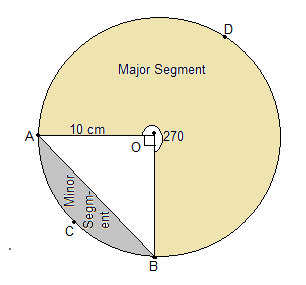
Here AB be the chord which is subtending an angle 90° at the center O.
It is given that the radius (r) of the circle = 10 cm
(i) Area of minor sector = (90/360°)×πr2
= (¼)×(22/7)×102
Or, Area of minor sector = 78.5 cm2
Also, area of ΔAOB = ½×OB×OA
Here, OB and OA are the radii of the circle i.e. = 10 cm
So, area of ΔAOB = ½×10×10
= 50 cm2
Now, area of minor segment = area of minor sector – area of ΔAOB
= 78.5 – 50
= 28.5 cm2
(ii) Area of major sector = Area of circle – Area of minor sector
= (3.14×10²)-78.5
= 235.5 cm2
5. In a circle of radius 21 cm, an arc subtends an angle of 60° at the centre. Find:
(i) the length of the arc
(ii) area of the sector formed by the arc
(iii) area of the segment formed by the corresponding chord
Solution:
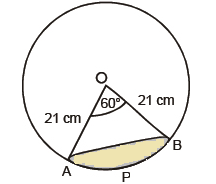
Given,
Radius = 21 cm
θ = 60°
(i) Length of an arc = θ/360°×Circumference(2πr)
∴ Length of an arc AB = (60°/360°)×2×(22/7)×21
= (1/6)×2×(22/7)×21
Or Arc AB Length = 22cm
(ii) It is given that the angle subtend by the arc = 60°
So, area of the sector making an angle of 60° = (60°/360°)×π r2 cm2
= 441/6×22/7 cm2
Or, the area of the sector formed by the arc APB is 231 cm2
(iii) Area of segment APB = Area of sector OAPB – Area of ΔOAB
Since the two arms of the triangle are the radii of the circle and thus are equal, and one angle is 60°, ΔOAB is an equilateral triangle. So, its area will be √3/4×a2 sq. Units.
Area of segment APB = 231-(√3/4)×(OA)2
= 231-(√3/4)×212
Or, Area of segment APB = [231-(441×√3)/4] cm2
6. A chord of a circle of radius 15 cm subtends an angle of 60° at the centre. Find the areas of the corresponding minor and major segments of the circle. (Use π = 3.14 and √3 = 1.73)
Solution:
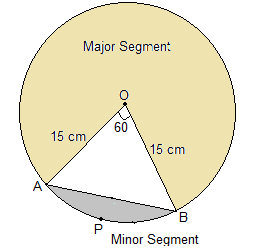
Given,
Radius = 15 cm
θ = 60°
So,
Area of sector OAPB = (60°/360°)×πr2 cm2
= 225/6 πcm2
Now, ΔAOB is equilateral as two sides are the radii of the circle and hence equal and one angle is 60°
So, Area of ΔAOB = (√3/4) ×a2
Or, (√3/4) ×152
∴ Area of ΔAOB = 97.31 cm2
Now, area of minor segment APB = Area of OAPB – Area of ΔAOB
Or, area of minor segment APB = ((225/6)π – 97.31) cm2 = 20.43 cm2
And,
Area of major segment = Area of circle – Area of segment APB
Or, area of major segment = (π×152) – 20.4 = 686.06 cm2
7. A chord of a circle of radius 12 cm subtends an angle of 120° at the centre. Find the area of the corresponding segment of the circle. (Use π = 3.14 and √3 = 1.73)
Solution:
Radius, r = 12 cm
Now, draw a perpendicular OD on chord AB and it will bisect chord AB.
So, AD = DB
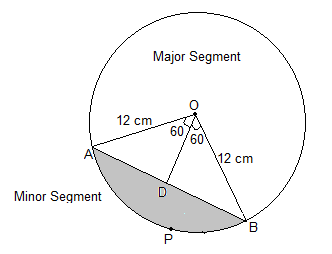
Now, the area of the minor sector = (θ/360°)×πr2
= (120/360)×(22/7)×122
= 150.72 cm2
Consider the ΔAOB,
∠ OAB = 180°-(90°+60°) = 30°
Now, cos 30° = AD/OA
√3/2 = AD/12
Or, AD = 6√3 cm
We know OD bisects AB. So,
AB = 2×AD = 12√3 cm
Now, sin 30° = OD/OA
Or, ½ = OD/12
∴ OD = 6 cm
So, the area of ΔAOB = ½ × base × height
Here, base = AB = 12√3 and
Height = OD = 6
So, area of ΔAOB = ½×12√3×6 = 36√3 cm = 62.28 cm2
∴ Area of the corresponding Minor segment = Area of the Minor sector – Area of ΔAOB
= 150.72 cm2– 62.28 cm2 = 88.44 cm2
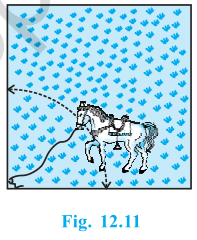
8. A horse is tied to a peg at one corner of a square shaped grass field of side 15 m by means of a 5 m long rope (see Fig. 12.11). Find
(i) the area of that part of the field in which the horse can graze.
(ii) the increase in the grazing area if the rope were 10 m long instead of 5 m. (Use π = 3.14)
Solution:
As the horse is tied at one end of a square field, it will graze only a quarter (i.e. sector with θ = 90°) of the field with radius 5 m.
Here, the length of rope will be the radius of the circle i.e. r = 5 m
It is also known that the side of square field = 15 m
(i) Area of circle = πr2 = 22/7 × 52 = 78.5 m2
Now, the area of the part of the field where the horse can graze = ¼ (the area of the circle) = 78.5/4 = 19.625 m2
(ii) If the rope is increased to 10 m,
Area of circle will be = πr2 =22/7×102 = 314 m2
Now, the area of the part of the field where the horse can graze = ¼ (the area of the circle)
= 314/4 = 78.5 m2
∴ Increase in the grazing area = 78.5 m2 – 19.625 m2 = 58.875 m2
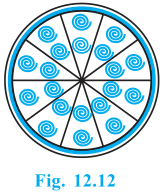
9. A brooch is made with silver wire in the form of a circle with diameter 35 mm. The wire is also used in making 5 diameters which divide the circle into 10 equal sectors as shown in Fig. 12.12. Find:
(i) the total length of the silver wire required.
(ii) the area of each sector of the brooch.
Solution:
Diameter (D) = 35 mm
Total number of diameters to be considered= 5
Now, the total length of 5 diameters that would be required = 35×5 = 175
Circumference of the circle = 2πr
Or, C = πD = 22/7×35 = 110
Area of the circle = πr2
Or, A = (22/7)×(35/2)2 = 1925/2 mm2
(i) Total length of silver wire required = Circumference of the circle + Length of 5 diameter
= 110+175 = 285 mm
(ii) Total Number of sectors in the brooch = 10
So, the area of each sector = total area of the circle/number of sectors
∴ Area of each sector = (1925/2)×1/10 = 385/4 mm2
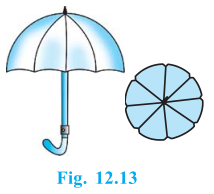
10. An umbrella has 8 ribs which are equally spaced (see Fig. 12.13). Assuming umbrella to be a flat circle of radius 45 cm, find the area between the two consecutive ribs of the umbrella.
Solution:
The radius (r) of the umbrella when flat = 45 cm
So, the area of the circle (A) = πr2 = (22/7)×(45)2 =6364.29 cm2
Total number of ribs (n) = 8
∴ The area between the two consecutive ribs of the umbrella = A/n
6364.29/8 cm2
Or, The area between the two consecutive ribs of the umbrella = 795.5 cm2
11. A car has two wipers which do not overlap. Each wiper has a blade of length 25 cm sweeping through an angle of 115°. Find the total area cleaned at each sweep of the blades.
Solution:
Given,
Radius (r) = 25 cm
Sector angle (θ) = 115°
Since there are 2 blades,
The total area of the sector made by wiper = 2×(θ/360°)×π r2
= 2×(115/360)×(22/7)×252
= 2×158125/252 cm2
= 158125/126 = 1254.96 cm2
12. To warn ships for underwater rocks, a lighthouse spreads a red colored light over a sector of angle 80° to a distance of 16.5 km. Find the area of the sea over which the ships are warned.
(Use π = 3.14)
Solution:
Let O bet the position of Lighthouse.

Here the radius will be the distance over which light spreads.
Given, radius (r) = 16.5 km
Sector angle (θ) = 80°
Now, the total area of the sea over which the ships are warned = Area made by the sector
Or, Area of sector = (θ/360°)×πr2
= (80°/360°)×πr2 km2
= 189.97 km2
13. A round table cover has six equal designs as shown in Fig. 12.14. If the radius of the cover is 28 cm, find the cost of making the designs at the rate of ₹ 0.35 per cm2 . (Use √3 = 1.7)
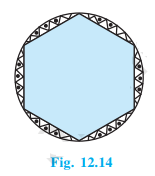
Solution:
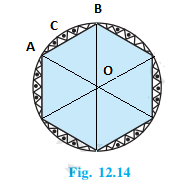
Total number of equal designs = 6
AOB= 360°/6 = 60°
Radius of the cover = 28 cm
Cost of making design = ₹ 0.35 per cm2
Since the two arms of the triangle are the radii of the circle and thus are equal, and one angle is 60°, ΔAOB is an equilateral triangle. So, its area will be (√3/4)×a2 sq. units
Here, a = OA
∴ Area of equilateral ΔAOB = (√3/4)×282 = 333.2 cm2
Area of sector ACB = (60°/360°)×πr2 cm2
= 410.66 cm2
So, area of a single design = area of sector ACB – area of ΔAOB
= 410.66 cm2 – 333.2 cm2 = 77.46 cm2
∴ Area of 6 designs = 6×77.46 cm2 = 464.76 cm2
So, total cost of making design = 464.76 cm2 ×Rs.0.35 per cm2
= Rs. 162.66
14. Tick the correct solution in the following:
Area of a sector of angle p (in degrees) of a circle with radius R is
(A) p/180 × 2πR
(B) p/180 × π R2
(C) p/360 × 2πR
(D) p/720 × 2πR2
Solution:
The area of a sector = (θ/360°)×πr2
Given, θ = p
So, area of sector = p/360×πR2
Multiplying and dividing by 2 simultaneously,
= (p/360)×2/2×πR2
= (2p/720)×2πR2
So, option (D) is correct.
Exercise: 12.3 (Page No: 234)
1. Find the area of the shaded region in Fig. 12.19, if PQ = 24 cm, PR = 7 cm and O is the centre of the circle.

Solution:
Here, P is in the semi-circle and so,
P = 90°
So, it can be concluded that QR is hypotenuse of the circle and is equal to the diameter of the circle.
∴ QR = D
Using Pythagorean theorem,
QR2 = PR2+PQ2
Or, QR2 = 72+242
QR= 25 cm = Diameter
Hence, the radius of the circle = 25/2 cm
Now, the area of the semicircle = (πR2)/2
= (22/7)×(25/2)×(25/2)/2 cm2
= 13750/56 cm2 = 245.54 cm2
Also, area of the ΔPQR = ½×PR×PQ
=(½)×7×24 cm2
= 84 cm2
Hence, the area of the shaded region = 245.54 cm2-84 cm2
= 161.54 cm2
2. Find the area of the shaded region in Fig. 12.20, if radii of the two concentric circles with centre O are 7 cm and 14 cm respectively and AOC = 40°.
Solution:

Given,
Angle made by sector = 40°,
Radius the inner circle = r = 7 cm, and
Radius of the outer circle = R = 14 cm
We know,
Area of the sector = (θ/360°)×πr2
So, Area of OAC = (40°/360°)×πr2 cm2
= 68.44 cm2
Area of the sector OBD = (40°/360°)×πr2 cm2
= (1/9)×(22/7)×72 = 17.11 cm2
Now, area of the shaded region ABDC = Area of OAC – Area of the OBD
= 68.44 cm2 – 17.11 cm2 = 51.33 cm2
3. Find the area of the shaded region in Fig. 12.21, if ABCD is a square of side 14 cm and APD and BPC are semicircles.

Solution:
Side of the square ABCD (as given) = 14 cm
So, Area of ABCD = a2
= 14×14 cm2 = 196 cm2
We know that the side of the square = diameter of the circle = 14 cm
So, side of the square = diameter of the semicircle = 14 cm
∴ Radius of the semicircle = 7 cm
Now, area of the semicircle = (πR2)/2
= (22/7×7×7)/2 cm2 =
= 77 cm2
∴ Area of two semicircles = 2×77 cm2 = 154 cm2
Hence, area of the shaded region = Area of the Square – Area of two semicircles
= 196 cm2 -154 cm2
= 42 cm2
4. Find the area of the shaded region in Fig. 12.22, where a circular arc of radius 6 cm has been drawn with vertex O of an equilateral triangle OAB of side 12 cm as centre.

Solution:
It is given that OAB is an equilateral triangle having each angle as 60°
Area of the sector is common in both.
Radius of the circle = 6 cm.
Side of the triangle = 12 cm.
Area of the equilateral triangle = (√3/4) (OA)2= (√3/40×122 = 36√3 cm2
Area of the circle = πR2 = (22/7)×62 = 792/7 cm2
Area of the sector making angle 60° = (60°/360°) ×πr2 cm2
= (1/6)×(22/7)× 62 cm2 = 132/7 cm2
Area of the shaded region = Area of the equilateral triangle + Area of the circle – Area of the sector
= 36√3 cm2 +792/7 cm2-132/7 cm2
= (36√3+660/7) cm2
5. From each corner of a square of side 4 cm a quadrant of a circle of radius 1 cm is cut and also a circle of diameter 2 cm is cut as shown in Fig. 12.23. Find the area of the remaining portion of the square.
Solution:
Side of the square = 4 cm
Radius of the circle = 1 cm
Four quadrant of a circle are cut from corner and one circle of radius are cut from middle.
Area of square = (side)2= 42 = 16 cm2
Area of the quadrant = (πR2)/4 cm2 = (22/7)×(12)/4 = 11/14 cm2
∴ Total area of the 4 quadrants = 4 ×(11/14) cm2 = 22/7 cm2
Area of the circle = πR2 cm2 = (22/7×12) = 22/7 cm2
Area of the shaded region = Area of square – (Area of the 4 quadrants + Area of the circle)
= 16 cm2-(22/7) cm2+(22/7) cm2
= 68/7 cm2
6. In a circular table cover of radius 32 cm, a design is formed leaving an equilateral triangle ABC in the middle as shown in Fig. 12.24. Find the area of the design.

Solution:
Radius of the circle = 32 cm
Draw a median AD of the triangle passing through the centre of the circle.
⇒ BD = AB/2
Since, AD is the median of the triangle
∴ AO = Radius of the circle = (2/3) AD
⇒ (2/3)AD = 32 cm
⇒ AD = 48 cm
In ΔADB,
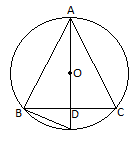
By Pythagoras theorem,
AB2 = AD2 +BD2
⇒ AB2 = 482+(AB/2)2
⇒ AB2 = 2304+AB2/4
⇒ 3/4 (AB2)= 2304
⇒ AB2 = 3072
⇒ AB= 32√3 cm
Area of ΔADB = √3/4 ×(32√3)2 cm2 = 768√3 cm2
Area of circle = πR2 = (22/7)×32×32 = 22528/7 cm2
Area of the design = Area of circle – Area of ΔADB
= (22528/7 – 768√3) cm2
7. In Fig. 12.25, ABCD is a square of side 14 cm. With centres A, B, C and D, four circles are drawn such that each circle touch externally two of the remaining three circles. Find the area of the shaded region.

Solution:
Side of square = 14 cm
Four quadrants are included in the four sides of the square.
∴ Radius of the circles = 14/2 cm = 7 cm
Area of the square ABCD = 142 = 196 cm2
Area of the quadrant = (πR2)/4 cm2 = (22/7) ×72/4 cm2
= 77/2 cm2
Total area of the quadrant = 4×77/2 cm2 = 154cm2
Area of the shaded region = Area of the square ABCD – Area of the quadrant
= 196 cm2 – 154 cm2
= 42 cm2
8. Fig. 12.26 depicts a racing track whose left and right ends are semicircular.
The distance between the two inner parallel line segments is 60 m and they are each 106 m long. If the track is 10 m wide, find:
(i) the distance around the track along its inner edge
(ii) the area of the track.

Solution:
Width of the track = 10 m
Distance between two parallel lines = 60 m
Length of parallel tracks = 106 m
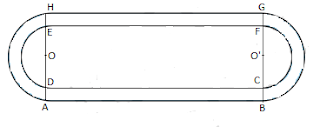
DE = CF = 60 m
Radius of inner semicircle, r = OD = O’C
= 60/2 m = 30 m
Radius of outer semicircle, R = OA = O’B
= 30+10 m = 40 m
Also, AB = CD = EF = GH = 106 m
Distance around the track along its inner edge = CD+EF+2×(Circumference of inner semicircle)
= 106+106+(2×πr) m = 212+(2×22/7×30) m
= 212+1320/7 m = 2804/7 m
Area of the track = Area of ABCD + Area EFGH + 2 × (area of outer semicircle) – 2 × (area of inner semicircle)
= (AB×CD)+(EF×GH)+2×(πr2/2) -2×(πR2/2) m2
= (106×10)+(106×10)+2×π/2(r2-R2) m2
= 2120+22/7×70×10 m2
= 4320 m2
9. In Fig. 12.27, AB and CD are two diameters of a circle (with centre O) perpendicular to each other and OD is the diameter of the smaller circle. If OA = 7 cm, find the area of the shaded region.

Solution:
Radius of larger circle, R = 7 cm
Radius of smaller circle, r = 7/2 cm
Height of ΔBCA = OC = 7 cm
Base of ΔBCA = AB = 14 cm
Area of ΔBCA = 1/2 × AB × OC = (½)×7×14 = 49 cm2
Area of larger circle = πR2 = (22/7)×72 = 154 cm2
Area of larger semicircle = 154/2 cm2 = 77 cm2
Area of smaller circle = πr2 = (22/7)×(7/2)×(7/2) = 77/2 cm2
Area of the shaded region = Area of larger circle – Area of triangle – Area of larger semicircle + Area of smaller circle
Area of the shaded region = (154-49-77+77/2) cm2
= 133/2 cm2 = 66.5 cm2
10. The area of an equilateral triangle ABC is 17320.5 cm2. With each vertex of the triangle as centre, a circle is drawn with radius equal to half the length of the side of the triangle (see Fig. 12.28). Find the area of the shaded region. (Use π = 3.14 and √3 = 1.73205)

Solution:
ABC is an equilateral triangle.
∴ ∠ A = ∠ B = ∠ C = 60°
There are three sectors each making 60°.
Area of ΔABC = 17320.5 cm2
⇒ √3/4 ×(side)2 = 17320.5
⇒ (side)2 =17320.5×4/1.73205
⇒ (side)2 = 4×10⁴
⇒ side = 200 cm
Radius of the circles = 200/2 cm = 100 cm
Area of the sector = (60°/360°)×π r2 cm2
= 1/6×3.14×(100)2 cm2
= 15700/3cm2
Area of 3 sectors = 3×15700/3 = 15700 cm2
Thus, area of the shaded region = Area of equilateral triangle ABC – Area of 3 sectors
= 17320.5-15700 cm2 = 1620.5 cm2
11. On a square handkerchief, nine circular designs each of radius 7 cm are made (see Fig. 12.29). Find the area of the remaining portion of the handkerchief.

Solution:
Number of circular designs = 9
Radius of the circular design = 7 cm
There are three circles in one side of square handkerchief.
∴ Side of the square = 3×diameter of circle = 3×14 = 42 cm
Area of the square = 42×42 cm2 = 1764 cm2
Area of the circle = π r2 = (22/7)×7×7 = 154 cm2
Total area of the design = 9×154 = 1386 cm2
Area of the remaining portion of the handkerchief = Area of the square – Total area of the design = 1764 – 1386 = 378 cm2
12. In Fig. 12.30, OACB is a quadrant of a circle with centre O and radius 3.5 cm. If OD = 2 cm, find the area of the
(i) quadrant OACB,
(ii) shaded region.

Solution:
Radius of the quadrant = 3.5 cm = 7/2 cm
(i) Area of quadrant OACB = (πR2)/4 cm2
= (22/7)×(7/2)×(7/2)/4 cm2
= 77/8 cm2
(ii) Area of triangle BOD = (½)×(7/2)×2 cm2
= 7/2 cm2
Area of shaded region = Area of quadrant – Area of triangle BOD
= (77/8)-(7/2) cm2 = 49/8 cm2
= 6.125 cm2
13. In Fig. 12.31, a square OABC is inscribed in a quadrant OPBQ. If OA = 20 cm, find the area of the shaded region. (Use π = 3.14)

Solution:
Side of square = OA = AB = 20 cm
Radius of the quadrant = OB
OAB is right angled triangle
By Pythagoras theorem in ΔOAB,
OB2 = AB2+OA2
⇒ OB2 = 202 +202
⇒ OB2 = 400+400
⇒ OB2 = 800
⇒ OB= 20√2 cm
Area of the quadrant = (πR2)/4 cm2 = (3.14/4)×(20√2)2 cm2 = 628cm2
Area of the square = 20×20 = 400 cm2
Area of the shaded region = Area of the quadrant – Area of the square
= 628-400 cm2 = 228cm2
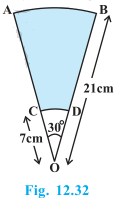
14. AB and CD are respectively arcs of two concentric circles of radii 21 cm and 7 cm and centre O (see Fig. 12.32). If ∠AOB = 30°, find the area of the shaded region.
Solution:
Radius of the larger circle, R = 21 cm
Radius of the smaller circle, r = 7 cm
Angle made by sectors of both concentric circles = 30°
Area of the larger sector = (30°/360°)×πR2 cm2
= (1/12)×(22/7)×212 cm2
= 231/2cm2
Area of the smaller circle = (30°/360°)×πr2 cm2
= 1/12×22/7×72 cm2
=77/6 cm2
Area of the shaded region = (231/2) – (77/6) cm2
= 616/6 cm2 = 308/3cm2
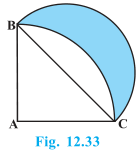
15. In Fig. 12.33, ABC is a quadrant of a circle of radius 14 cm and a semicircle is drawn with BC as diameter. Find the area of the shaded region.
Solution:
Radius of the quadrant ABC of circle = 14 cm
AB = AC = 14 cm
BC is diameter of semicircle.
ABC is right angled triangle.
By Pythagoras theorem in ΔABC,
BC2 = AB2 +AC2
⇒ BC2 = 142 +142
⇒ BC = 14√2 cm
Radius of semicircle = 14√2/2 cm = 7√2 cm
Area of ΔABC =( ½)×14×14 = 98 cm2
Area of quadrant = (¼)×(22/7)×(14×14) = 154 cm2
Area of the semicircle = (½)×(22/7)×7√2×7√2 = 154 cm2
Area of the shaded region =Area of the semicircle + Area of ΔABC – Area of quadrant
= 154 +98-154 cm2 = 98cm2
16. Calculate the area of the designed region in Fig. 12.34 common between the two quadrants of circles of radius 8 cm each.
Solution:

AB = BC = CD = AD = 8 cm
Area of ΔABC = Area of ΔADC = (½)×8×8 = 32 cm2
Area of quadrant AECB = Area of quadrant AFCD = (¼)×22/7×82
= 352/7 cm2
Area of shaded region = (Area of quadrant AECB – Area of ΔABC) = (Area of quadrant AFCD – Area of ΔADC)
= (352/7 -32)+(352/7- 32) cm2
= 2×(352/7-32) cm2
= 256/7 cm2
NCERT Solutions for Class 10 Maths Chapter 12 Areas Related to Circles
The 12th Chapter of NCERT Solutions for Class 10 Maths covers the concepts of perimeter (circumference) and area of a circle and applies this knowledge in finding the areas of two special ‘parts’ of a circular region known as sector and segment.
Areas Related to Circles is a part of Mensuration, and this Unit holds a total weightage of 10 marks in the final exam. In the final examination, one question is sometimes asked from this chapter.
List of Exercises in class 10 Maths Chapter 12
Exercise 12.1 Solutions (5 Solved Questions)
Exercise 12.2 Solutions (14 Solved Questions)
Exercise 12.3 Solutions (16 Solved Questions)
NCERT solutions for Class 10 Maths Chapter 12 is about parts of circle, their measurements and areas of plane figures. BYJU’S subject experts have prepared solutions for each question adhering to the CBSE syllabus.
Area related to circles, the chapter of Class 10 consists of important topics such as;
| Exercise | Topic |
| 12.1 | Introduction |
| 12.2 | Perimeter and Area of a Circle |
| 12.3 | Areas of Sector and Segment of a Circle |
| 12.4 | Areas of Combinations of Plane Figures |
| 12.5 | Summary |
Key Features of NCERT Solutions for Class 10 Maths Chapter 12 Areas Related to Circles
- NCERT Solutions help students strengthen their concepts on circle related areas.
- Questions are explained using diagrams which make learning more interactive and comprehensive.
- Easy and understandable language used in NCERT solutions.
- Step by step solving approach helps students to clear their basics.
- Helps students to solve complex problems at their own pace.
Frequently Asked Questions on NCERT Solutions for Class 10 Maths Chapter 12
What is the importance of studying NCERT Solutions for Class 10 Maths Chapter 12?
The solutions of NCERT Class 10 Maths Chapter 12 helps students in procuring a summary of the question paper pattern, including a variety of questions, such as mostly repeating questions, concise and long answer type questions, multiple-choice questions, marks etc. The numerous you solve, the more assurance you will get towards your success.
Mention concepts that are important from an exam perspective in NCERT Solutions for Class 10 Maths Chapter 12?
The important from an exam perspective in NCERT Solutions for Class 10 Maths Chapter 12 Introduction of area of circle, perimeter and area of a circle, areas of sector and segment of a circle, areas of combinations of plane figures and lastly explains the summary of the whole chapter.
How many exercises are there in NCERT Solutions for Class 10 Maths Chapter 12?
There are 3 exercises in NCERT Solutions for Class 10 Maths Chapter 12. First exercise has 5 questions, second exercise has 14 exercises and last and final exercise has 16 questions based on perimeter and area of a circle, areas of sector and segment of a circle and areas of combinations of plane figure.